The Hidden Risks of DIY Dent Repair: What You’re Not Being Told
DIY dent repair often causes far more damage than the kits suggest. Heat, suction, and glue can blister paint, tear clear coat, and distort metal in ways that are difficult or impossible to reverse. Most DIYers underestimate how metal reacts under stress and tension. This guide breaks down the hidden risks and explains why professional paintless dent repair is the safer, more reliable option.
🔹 DIY Dent Repair Risks: The Illusion of Simplicity
Dents may look simple on the surface, but the metal underneath tells a different story. Whether you’re dealing with steel, aluminum, or a hybrid alloy, each panel reacts differently to pressure, heat, and tool contact. Even experienced DIYers often misjudge how metals behave — especially when alloy composition and thickness vary wildly. Some panels are rigid and nearly impossible to bend, while others (like the Toyota Prius or Ford Maverick) behave like yogurt metal, flexing unpredictably and distorting easily.
🔸Key points:
- Most dents involve hidden bracing or double panels.
- Alloy type and thickness affect repair strategy.
- Once metal becomes “trained,” it loses surface tension and pops like a jelly jar lid.
- At that point, the panel may need to be replaced entirely.
Internal links: → Learn the basics of PDR – Any enthusiast should know the basics of paintless dent removal
🔹 Common DIY Dent Repair Risks and Hidden Consequences
🔥 Heat Gun Dent Repair
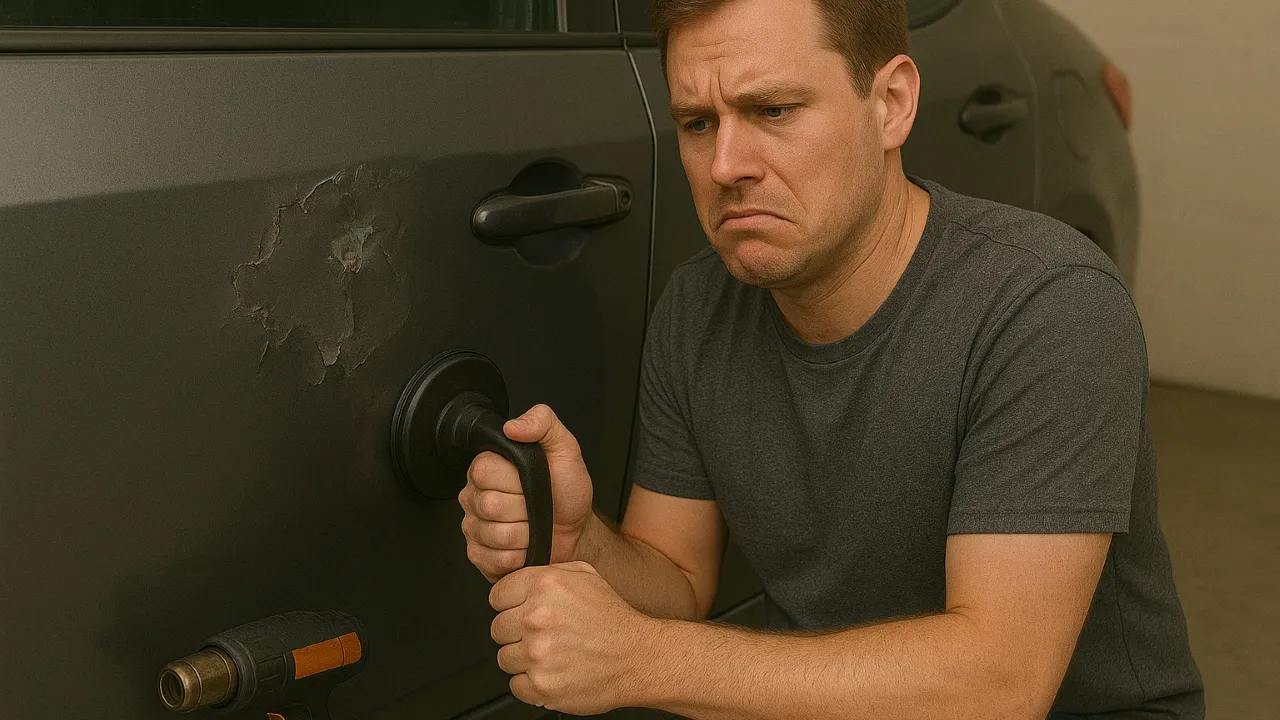
- Can blister, warp, or bake the paint, permanently altering its color.
- Risks cracking glass when used near panel edges.
- No control over heat distribution across curved surfaces.
🧲 Glue Pull Kits
- Pull paint right off the car — leaving torn, jagged edges that look terrible.
- Overpulls metal 99.9% of the time.
- Requires professional tools and experience to flatten it back out.
- Without finesse, the metal becomes trained and unrecoverable.
🌀 Suction Cups & Plunger Tricks
- Only attack the deepest point of the dent.
- Lack finesse to control tension flow across the panel.
- Cause rippling waves that frustrate PDR techs and often can’t be removed.
- Glue tabs are notorious for causing paint damage from DIY kits.
- DIY attempts always make it worse.
❄️ Dry Ice
- Damages paint resin and pigments.
- Weakens resin adhesion to metal — especially in aluminum.
- Has little to no effect on aluminum panels.
- Dry ice can cause paint damage from DIY kits by weakening resin adhesion and pigment stability.
💧 Boiling Water
- Can warm a panel, but risks heating edges near glass and breaking glass.
- Makes everything wet and messy.
- In 20 years of professional PDR, you’ve never seen a dent pop out from boiling water.
- It’s possible — but the odds aren’t in your favor.
Internal links: → 11 PDR Myths Explained – Learn the most common misunderstanding of paintless dent removal
🔹 Aluminum vs. Steel: Why DIY Fails More Often Than You Think
These material differences are a major reason DIY dent repair risks often go unnoticed — especially when alloy behavior is misunderstood. Aluminum gets most of the attention in DIY failure stories, but steel and hybrid alloys are just as misunderstood. DIYers often assume all metal behaves the same — but that’s far from true. Each material has its own spring-back resistance, heat tolerance, and memory. Without knowing what you’re working with, you’re flying blind.
🔸Key points:
- Aluminum resists reshaping and springs back aggressively.
- Steel is more forgiving but still requires precision.
- Most DIY kits are designed for steel — not aluminum.
- Even pros need specialized tools and training.
- Link to your Aluminum vs Steel blog for deeper context.
Internal links: → Understand differences between aluminum vs steel – Learn more about this subtle topic for a deeper understanding of metal bending
🔹 DIY Dent Repair Risks They Don’t Warn You About
Most dent repair DIY kits ignore the dangers of fixing car dents yourself — especially when metal tension and paint chemistry are involved — but it should. These kits skip the most important details: material type, paint compatibility, heat thresholds, and structural access.
🔸Key points:
- No kit includes paint compatibility charts or heat thresholds.
- No warning about panel seams, bracing, or double-wall construction.
- No accountability for damage caused.
- No guidance on how to reverse overpull or restore surface tension.
Internal links: → Example of PDR work being done – It might look easy, but this took several hours from a master tech
🔹 What to Ask Before You Try DIY
If you’re unsure about any of these, the dangers of fixing car dents yourself can quickly outweigh the savings. Before you reach for a heat gun or glue tab, ask yourself these questions. If you can’t answer confidently, it’s time to call a professional.
🔸Checklist:
- ✅ Do you know what material your panel is made of?
- ✅ Can you control heat precisely across curved surfaces?
- ✅ Do you understand how glue pull affects paint tension?
- ✅ Are you prepared to pay more if the repair fails?
Internal links: → Finding a quality PDR business – It’s probably better to find a professional
→ If you’re comparing DIY risks to professional repair, my PDR cost guide shows what real dent repair pricing looks like.
Summary
If you’re weighing DIY dent repair risks against professional help, here’s what to consider. Paintless dent repair isn’t a magic trick. It’s a craft rooted in physics, patience, and precision. DIY kits oversimplify a process that demands experience and the right tools. When it comes to preserving your paint and restoring your panel, shortcuts cost more in the long run. Even professional trainers at Dent Time warn that DIY attempts often lead to high spots, warped panels, and costly mistakes — especially when finesse and tool control are missing.
Additional Internal links:
- This guide is part of our Paintless Dent Repair Resource Hub — explore more prep and protection tips.
- Learn more about Paintless Dent Repair on our main service page — see how the process works from start to finish.
- Have more questions? Visit our Paintless Dent Repair FAQ for quick, clear answers.