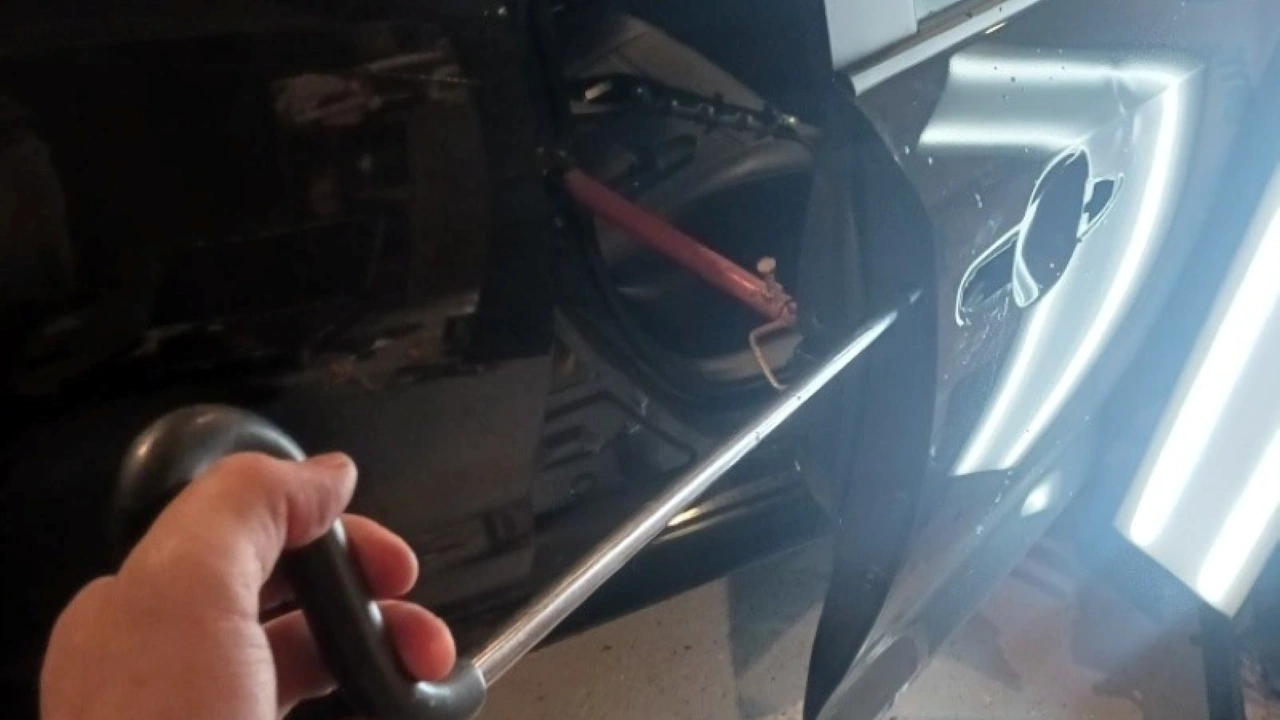
How Does Paintless Dent Repair Work?
Paintless Dent Repair works by guiding stretched metal back into its original shape using controlled pressure, specialized tools, and precise tension management. When the paint is intact and the metal’s memory remains, a skilled technician can relax the distortion and restore clean factory contours without sanding, fillers, or repainting.
🔹What Happens to Metal When a Dent Forms
A dent isn’t just a low spot — it’s stretched metal with increased surface area, and understanding that stretch is the foundation of all PDR.
🔸Metal Stretching — Quick Breakdown
- Impact increases surface area
- The deeper the dent → the longer the slope → the more the metal stretches
- The valley is the most stretched (and never evenly)
- Stretched metal behaves like a distorted jelly jar lid — unstable, wants to pop in/out
🔸Steel Pencil Analogy (condensed)
- Pull a steel pencil → it gets longer and thinner
- Same concept in 3D when a dent forms
- More surface area = harder to return to factory tension
For a full breakdown, see: → What Paintless Dent Repair actually is
🔹How PDR Actually Moves the Metal
PDR works by reversing that stretch and guiding the metal back into its natural, relaxed shape using controlled pressure and tension management.
🔸Core Principles:
- Metal has a memory — it relaxes only in its original shape
- PDR “massages” the stretched metal back into that shape
- When memory is intact → dent can disappear completely
- When memory is lost (deep/sharp dents) → tech must recreate tension
🔸Result Expectations:
| Dent Type | Metal Memory | Expected Result |
|---|---|---|
| Light–moderate dents | Memory intact | 100% or near‑perfect |
| Deep/sharp dents | Memory lost | 95–99% to the eye |
| Overstretched dents | Memory gone | PDR may not be ideal |
For a full breakdown, see: → Advantages of Paintless Dent Repair (Why It’s the Smarter Choice)
🔹Metal Limits: Steel vs Aluminum
Different metals react differently to impact and repair, and knowing those limits is critical for avoiding cracks, tears, or paint damage.
🔸Steel:
- Less forgiving
- Tears easily if mishandled
- Heat must be controlled
- If torn → panel usually replaced
- Very few shops weld aluminum (complex + toxic vapors)
🔸Aluminum:
- Less forgiving
- Tears easily if mishandled
- Heat must be controlled
- If torn → panel usually replaced
- Very few shops weld aluminum (complex + toxic vapors)
For a full breakdown, see: → How PDR works on aluminum
🔹Tools & Access (Your Real Workflow)
PDR isn’t one tool or one technique — it’s a combination of rods, tips, glue pulling, lighting, and access decisions that change with every dent.
🔸Tools We Use Constantly:
- Rods
- Whale tails
- Knockdowns
- Blending hammers
- Glue pulling
- Hand tools
🔸Glue Pulling Rules:
- Only on OEM paint
- Rarely on flat areas
- Used mainly to lift the valley before tool work
- Not a “full repair” method — a setup move
🔸Tool Tip Strategy:
- Start with Tesa‑taped soft tips to restore general tension
- Protects backside eco‑coating
- Switch to sharp/needle tips for final detail
- Tape can crack paint on white aluminum body lines → use with caution
- Too much heat on aluminum = risk
🔹How To Read & Move a Dent
Before any pushing happens, a skilled tech studies the dent’s tension, crowns, metal flow, and lighting angles to understand how the panel wants to move.
🔸Our Process:
- Read the dent under proper lighting
- Identify crowns (tight/high areas)
- Release tension in the correct order
- Move metal like a “fluid” — pressure redistributes
- Finish with micro‑high/micro‑low correction
🔸Crowns Explained (our analogy):
- Crowns = compressed metal – stored energy
- Lower valley needs that energy returned
- Without crown control → panel never balances
🔸Lighting Technique:
- Silver/white cars hide detail
- Indoors + shallow viewing angle = essential
- Move light far away to see the last 5% of imbalance
🔹What’s Easy vs. What’s High‑Skill
Some dents fall into the “textbook PDR” category, while others require advanced tension control, metal reading, and realistic expectations.
🔸Textbook PDR (usually clean results):
- Shopping cart dings
- Door dings
- Minor collision dents (up to ~12″)
- Steel panels
- Light hail / acorn dents
🔸High‑Skill Repairs:
- Large stretched dents
- Damage over intrusion beams
- Deep creases
- Aluminum dents with sharp impact points
🔸Common Misconception:
- “The dent will just pop out.” → It never does. Every dent requires controlled metal movement.
- “DIY glue pullers will work in their hands.
For a full breakdown, see: → When PDR doesn’t work & see: → Why DIY is a bad idea
🔹Your Professional Approach
Your repair philosophy sets the tone for the entire experience — clear communication, precision work, and never cutting corners.
🔸Our Standards:
- Take your time
- Never settle for “good enough”
- Study metal behavior
- Practice new techniques
- Communicate clearly with customers
🔸Our Customer Process:
- Explain exactly what will be done
- Give access‑hole options + cost differences
- Send before/during/after photos
- Request reviews upfront
- Never raise the price mid‑job — ever
For a full breakdown, see: → my PDR cost guide – breaks down real pricing and the factors that affect it.
Summary
At its core, Paintless Dent Repair is about restoring your vehicle the right way — by moving stretched metal back into place without fillers or repainting. With proper technique and experience, PDR delivers clean, long‑lasting results while protecting the value of your car. For additional insight into the PDR process, here’s a helpful editorial resource: What Is Paintless Dent Removal?
Additional Internal links:
- This guide is part of our Paintless Dent Repair Resource Hub — explore more prep and protection tips.
- Learn more about Paintless Dent Repair on our main service page — see how the process works from start to finish.
- Have more questions? Visit our Paintless Dent Repair FAQ for quick, clear answer